When it comes to plus-size lingerie, shoulder strap comfort is easy to overlook. As the size increases, the garment also needs to support more weight. If too much of that weight stays concentrated around the shoulders, wearers may quickly feel pressure, soreness, or noticeable strap marks. Some products feel fine when first put on but become increasingly uncomfortable after several hours of wear. For plus-size lingerie brands, reducing shoulder strap pressure is not simply about making the straps wider. It requires careful attention to load-bearing, contact area, strap placement, and how weight is distributed across the entire garment.
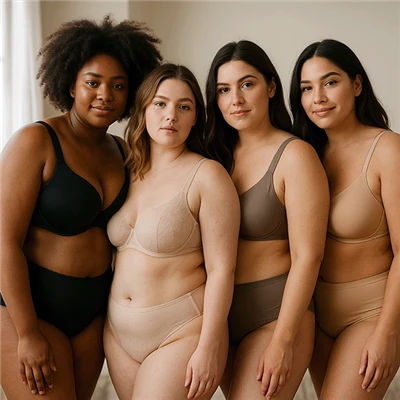
Why Does Plus-Size Lingerie Often Cause Shoulder Strap Pressure?
Shoulder strap pressure tends to become more noticeable in plus-size lingerie because the garment has a greater load to support. As cup volume and garment dimensions increase, the pulling force placed on the straps also changes. If the strap specifications are not adjusted accordingly, too much pressure may become concentrated around the shoulders. A wearer may initially notice only slight tightness, but after longer periods of wear, soreness and strap marks can become much more obvious.
Common problems include:
- Straps that are too narrow: Limited contact area causes weight to concentrate over a smaller area.
- Straps positioned too far outward: They can sit near the edge of the shoulder, making pulling and tension more noticeable during movement.
- Straps that are too short: Tightening the straps to keep the lingerie close to the body can place continuous tension on the shoulders.
- Highly concentrated attachment points: Excessive force around the front or back attachment areas can create localized pressure.
- The same strap specifications across all sizes: The garment may be enlarged for plus sizes while the straps retain standard-size specifications, making the load-bearing capacity less suitable.
Shoulder strap pressure is not simply a matter of the straps being too tight. Sometimes the strap length is reasonable, but the weight of the entire plus-size garment is still transferred upward through the straps, leaving the wearer feeling tired. During plus-size lingerie development, straps should be treated as part of the overall load-bearing structure rather than as an isolated component.
How Should Strap Width and Size Be Selected for Plus-Size Lingerie?
Wider straps can increase the contact area, but wider does not always mean more comfortable. Strap width, thickness, stretch, and length should be adjusted together with the garment size. Different plus-size ranges can have different load-bearing requirements. If every size uses exactly the same strap specifications, a design may work well in smaller sizes but create noticeably more shoulder pressure in larger sizes.
|
Strap Design Item |
What to Check |
Impact on Wearing Comfort |
|
Strap Width |
Whether the contact area is sufficient |
Affects how concentrated the shoulder pressure feels |
|
Strap Thickness |
Whether enough cushioning is provided |
Affects comfort during extended wear |
|
Strap Length |
Whether the adjustment range is appropriate |
Affects continuous pulling force on the shoulders |
|
Strap Position |
Whether the strap sits in a suitable area |
Affects pressure and freedom of movement |
|
Attachment Structure |
Whether tension is overly concentrated |
Affects localized pressure |
The key to plus-size lingerie strap design is finding the right balance. Straps that are too narrow can concentrate pressure, while excessive thickness may affect a lightweight feel. Straps that are too tight can cause shoulder discomfort, while overly loose straps may require constant adjustment. During product development, brands can define the load-bearing requirements for each size range first and then adjust the strap specifications instead of discovering shoulder discomfort only after the sample has been made.
How Can Plus-Size Lingerie Distribute Shoulder Pressure Beyond the Straps?
If the straps are expected to handle all of the weight, even wider straps may not fully solve the problem. A more practical solution is to let other parts of the garment share the load and reduce the amount of force concentrated on the shoulders. When the wearer moves, this helps prevent the straps from remaining under high tension and can make the garment more comfortable during extended wear.
Key areas to check include:
- Underband support: Allow the underband to carry part of the load and reduce continuous upward pulling on the straps.
- Side structure: Reduce additional pulling caused by excessive outward movement of the bust weight.
- Cup construction: Distribute weight more evenly and avoid excessive concentration in one area.
- Back attachment area: Provide a suitable load-bearing area to reduce localized pulling at the rear of the straps.
- Strap-to-garment connection: Make the transfer of force smoother and avoid sudden concentration at one attachment point.
Put simply, the straps should not have to "do all the work." Plus-size lingerie should divide the load so that the underband, cups, side structure, and back construction all contribute, while the straps mainly handle lifting and adjustment. When the load is distributed properly across the garment, the shoulders do not have to remain under constant tension.
How Should Shoulder Strap Pressure Be Tested During Plus-Size Lingerie Sampling?
Shoulder strap pressure is difficult to judge from the appearance of a sample alone. The real problems usually become clear when the garment is worn. With plus-size lingerie in particular, a short standing fitting may feel fine, while walking, sitting, raising the arms, or wearing the garment for several hours can produce a completely different experience. If sampling only involves a quick fitting, problems can easily carry over into bulk production.
During sample testing, brands should record:
- Standing fitting: Check whether the straps create obvious pressure on the shoulders.
- Arm movement: Check whether the straps suddenly become tight when the wearer raises the arms.
- Bending and sitting: See whether pressure increases when the body position changes.
- Extended wear: Check for soreness, pressure, or visible strap marks after several hours.
- Different shoulder shapes: Narrow, broad, and rounded shoulders can experience strap pressure differently.
Fitting feedback should be more specific than simply saying "the straps are uncomfortable." Record where the pressure occurs and when it starts. Is the front shoulder under pressure, or is there more pulling at the back? Does the discomfort appear immediately, or only after two or three hours of wear? The more specific the feedback, the easier it is to identify what needs to be changed. For brands developing plus-size lingerie through OEM/ODM manufacturing, sample-testing results can also be fed directly back into pattern development and production. A lingerie manufacturer such as CATONIE can maintain continuity between sampling, adjustments, and bulk production, helping keep strap specifications and finished-garment performance more consistent across sizes.
Reducing shoulder strap pressure in plus-size lingerie is not simply a matter of making the straps wider. Wearing comfort is affected by strap contact area, length, placement, attachment structure, and how the entire garment distributes its weight. Testing these details early in development and validating them through different movements and extended wear can help brands create designs that genuinely suit plus-size consumers. Less pressure on the shoulders means longer and more comfortable wear, which can make a real difference to the overall product experience.